We are entering a bold new age of mix design. Last year’s revision to British Standard BS 8500 was the biggest change to traditional concrete mixes since the 1980s, opening the door to a wide range of multi-component cements.
Concrete mixes can now contain a range of proportions of CEM I and limestone fines, in addition to GGBS or fly ash, potentially reducing the sector’s carbon emissions by 1 million tonnes a year. For precasters, this opens up a world of possibilities for optimising mixes. “What the standard facilitates is flexibility,” says the Mineral Products Association’s Gareth Wake. “As long as you can show that the combination conforms to a BS 8500 classification, you can mix those proportions as much as you like.”
Any innovation also has a tendency to foster more innovation – as mixes become more complex and less Portland cement-based, companies will explore new technologies for maintaining finish, consistency and early strength gain – the critical factor in precasters’ 24-hour production cycles. Derek Russell, Technical Director at Techrete, sees it as a watershed moment: “The standards have been the same for so long, so this is a great opportunity for the industry to question everything we’re doing.”
In many ways, architectural precast manufacturers are at the sharp end of mix innovation. While all precasters are having to find new ways of matching the early strength gain of Portland cement, cladding specialists also have to manage changes to colour, or texture caused by the addition of secondary cementitious materials (SCMs). “We’re all doing trials with different mixes,” says Dale Brown at Evans Concrete Products. “From an architectural point of view, it all depends on the colour of the mix – that’s the driver.”
At Techrete, Derek Russell estimates that about 200 mixes have been trialled over the past six months to ensure that the company can exactly match its existing range of products using multi-component cements, often accelerated with admixtures, and despite the time and investment involved, he believes there have been widespread advantages, beyond decarbonisation: “We’ve had to rebuild every mix from the ground up. In the factory, they’ve often realised that these low-carbon mixes are better in terms of workability. Then they ask us, can you fix this other mix as well?” Architects can see the benefits too: as companies upgrade their facilities to accommodate new mixes and admixture tanks, they are able to more finely control pigment and consistency, leading to more precise and controlled finishes.
In the world of visual concrete, it’s becoming clear that there is no one-size-fits-all solution to decarbonisation, but rather a constant process of balancing Portland cement and SCMs and trying to reduce the overall volume of concrete required, all depending on the specific architectural vision. “That’s the level of detail we go into on every project now,” adds Derek Russell. “It’s like an artisanal recipe.”
In terms of SCMs, trials of calcined clay – a significant waste stream from brick manufacture and mineral quarries – have revealed performance that compares favourably with fly ash, albeit with relatively slow strength gain that may be more suited to ready-mix applications. An interesting variation on this approach is being pioneered by the HS2 rail project, which is working on a circular process that involves taking the material excavated by its tunnel-boring machines, calcining it on-site and then using it as a binder on new infrastructure elements, potentially including precast tunnel segments.
Away from the high-stakes environment of a live construction site, under controlled factory conditions, the precast industry is perhaps the natural place to innovate with concrete mixes. Techrete’s Derek Russell certainly doesn’t see the revised BS 8500 as the end of the road: “This is going to be a journey now for the next four or five years. People will develop their designs, make the mixes work harder, and just keep pushing.”
For more information visit: www.mineralproducts.org
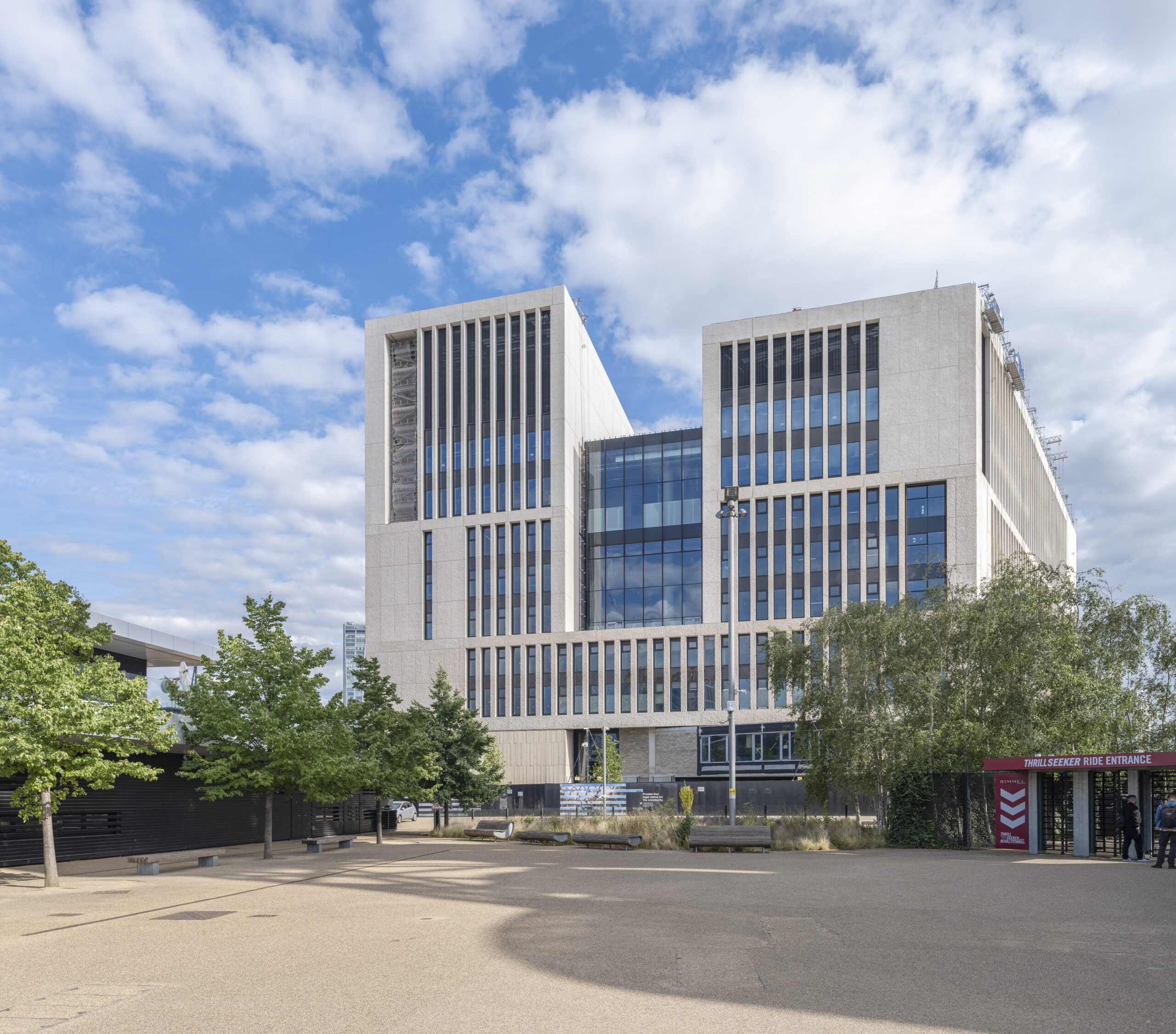
Image: Techrete façade on Marshgate UCL East. Courtesy Tim Fisher
Offsite Expo returns for 2024, visit www.offsite-expo.co.uk for more information!