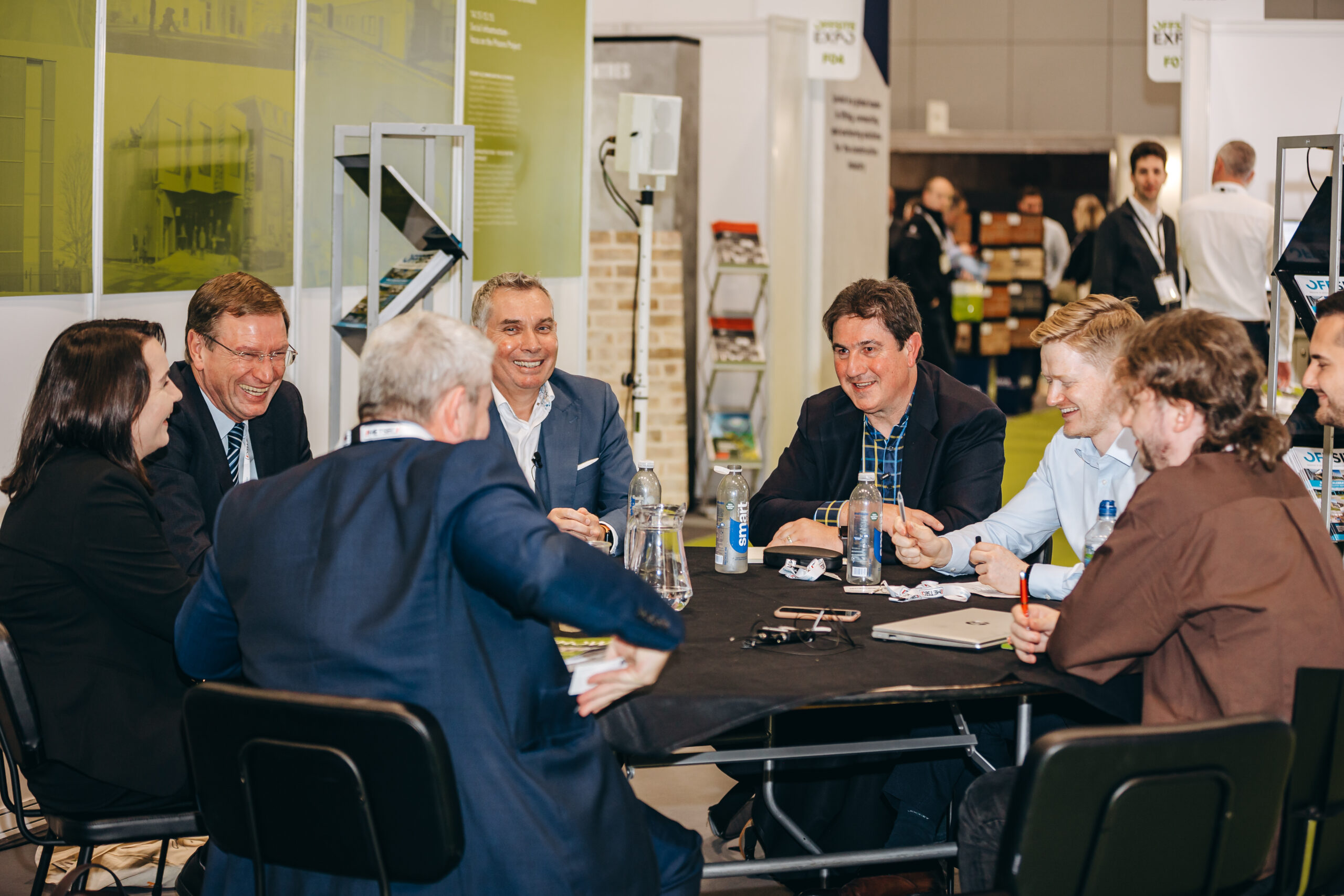
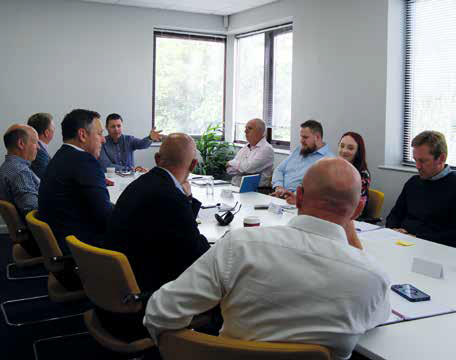
A recent roundtable hosted by MPA Precast, sought to understand the pressure points surrounding precast concrete and the role it plays in creating buildings that are durable, structurally robust and can withstand future climate shocks.
WITH CLIMATE RESILIENCE rising across the built environment agenda, the roundtable exposed a gap between what the industry already knows and what it is prepared to deliver. The discussion examined where precast and offsite approaches can make a practical difference and the importance of better policy decisions, clearer market signals and improved delivery culture.
Climate resilience is no longer a secondary technical issue sitting outside mainstream design and delivery. Flooding, overheating, storm intensity, water scarcity, wildfire risk and wider infrastructure disruption are all moving closer to the centre of the built environment conversation. Yet this roundtable made clear that the industry still does not treat those risks with the same urgency or structure that it now applies to embodied and operational carbon.
Resilience is rising but still not embedded
Convened to examine how the precast concrete sector can support the design, delivery and long-term performance of more resilient buildings and infrastructure, the session quickly moved beyond a simple material argument and into a harder question – if the risks are increasingly clear, why is resilient delivery still so inconsistent? For Elaine Toogood, Senior Director at MPA Concrete and The Concrete Centre, part of the answer is straightforward – adaptation still receives far less attention than mitigation. Elaine noted that climate resilience remains underdiscussed compared with sustainability and embodied carbon, despite the scale of the challenge. Work is happening, but too often in isolated pockets – overheating here, flooding there, supply chain resilience somewhere else. What is still missing is a joined-up approach that treats climate resilience as a standard design and performance requirement rather than a specialist add-on.
The risks are known but not the response
One of the strongest conclusions from the room was that policy and planning guidance are not keeping pace. Participants agreed that the framework remains too fragmented, too weakly enforced and too reactive. Overheating has at least begun to enter regulation more clearly, but even there the view was that current measures are partial and still need development. Flooding is better understood yet still addressed inconsistently and often too narrowly through the planning system.
Elsewhere, resilience remains trapped between voluntary guidance, fragmented standards and the hope that clients will choose to go further than the minimum. As a result, resilience is often treated as somebody else’s responsibility until the consequences become visible and expensive. The roundtable’s verdict was blunt and straightforward – too much of the sector is still operating reactively when it should already be designing ahead of risk.
 Where precast makes a practical difference
If the policy picture feels weak, the technical picture is much stronger. One of the more useful aspects of the roundtable was its focus on where precast and offsite approaches already offer credible resilience advantages.
Durability was one of the clearest. The briefing for the session explicitly framed precast around structural robustness, long design life, predictable performance and lower maintenance cycles. In discussion, which was reinforced by manufacturers and consultants who pointed to the value of systems built to last, able to tolerate harsher conditions and less reliant on fragile layers of materials or finishes over time.
Flood resilience was another major thread. Participants discussed the extent to which material choice is fundamental to performance in floodprone conditions, with mineral-based materials seen as offering obvious advantages over lighter systems more vulnerable to water damage. The discussion did not suggest that precast alone is the answer to flood resilience, but it did underline a practical point, that if the industry already knows certain materials are more robust in wet or wash-down scenarios, continuing to specify less resilient solutions in known risk contexts becomes harder to defend. Straightforward interventions such as raised sill levels, water bars and flood gates also featured in the conversation – not as futuristic answers, but as sensible measures that are still not being embedded consistently enough.
Thermal mass, overheating and the practical design gap
Overheating prompted some of the most useful exchanges. Suzanne Davenport, Associate at Studio Partington, and others highlighted the importance of thermal mass in helping buildings cope with rising temperatures, particularly in residential and student accommodation settings where single-aspect rooms, compact layouts and long occupation periods can create difficult conditions.
Participants argued that precast can play a much larger role here than it often does now, not through broad-brush claims but through basic building physics. What still holds this back is that these benefits are not consistently understood, valued or integrated across the design team. As several contributors suggested, the material may have the right properties, but the building still needs to be designed to use them properly.
Hox Park: resilience by client intent
 That point was sharpened by discussion of Hox Park, the Surrey student accommodation scheme raised during the roundtable by Suzanne Davenport. It gave the discussion a practical example of what resilient thinking can look like when it is designed in rather than added on.
At Hox Park in Surrey, a 499-bed student accommodation scheme was delivered using a fully offsite fabricated precast concrete superstructure supplied by Techrete. The project was used to show how exposed internal concrete could support both durability and thermal mass in student rooms, while deciduous planting formed part of the overheating response through seasonal shading. For a typology that is notoriously difficult from a thermal comfort perspective, which looked like a far more credible design response than leaving the problem to later mechanical fixes.
Hox Park also helped surface a wider commercial truth. The clients most likely to value resilience are often the ones who expect to live with the asset over time. That came through clearly in the discussion around student accommodation and social housing, where long-term operators care directly about durability, maintenance, asset performance and whether a building remains insurable and usable.
Several contributors contrasted that with more short-term development models, where immediate cost is highly visible but longer-term risk sits further down the line. In practice, that shorttermism means resilience measures are still too easily designed out, even when their long-run value is understood. That was one of the roundtable’s most important underlying messages – resilience is not just a technical issue, but an ownership and incentive issue.
Insurers and investors can drive change
Insurers, lenders and investors emerged as important figures in the conversation. Yetunde Abdul, Director of Industry Transformation at UKGBC, joined the discussion around the organisation’s Climate Resilience Roadmap and the next phase of stakeholder action plans. A clear message was that deeper engagement with insurers and banks is now essential, partly because formal policy is moving too slowly, and partly because those actors may end up applying more immediate pressure through finance, underwriting and risk assessment.
The insurance sector was discussed as both a frustration and a potential lever. Frustrating because some current assessments remain too blunt, but potentially powerful because insurers hold data on claims, costs and failure patterns that could influence higher standards if used more intelligently. A broader point was that clients are still not consistently asking for climate adaptation in a serious, structured way. Without a stronger policy stick or a clearer monetary signal, resilience is too often seen as desirable but non-essential.
The conversation also touched on how climate risk might be made more visible at the point of sale, including the idea of climate performance certificates in the same broad spirit as energy performance certificates (EPCs). The logic is straightforward – if resilience affects future value, insurability and upgrade cost, the market needs a clearer way of seeing that before the damage happens, not after.
Known solutions and adoption problems
Derek Russell, Director of Innovation, Product Development & Sustainability at Techrete, brought a useful engineering perspective shaped by work across concrete, ports, coastal defence and flood modelling. More broadly, the discussion argued that resilience should not be reduced to a single hazard or a single metric. The risks are systemic. They affect buildings, infrastructure, operations and supply chains all at once. The implication for design and specification is that resilience cannot sit in one corner of the brief. It must be built into the logic of the project from the start.
What gave the session its edge was that it did not suggest the industry lacks technical knowledge. In many respects, the opposite is true. The routes to better resilience are often already understood. More robust material choices, earlier risk mapping, stronger passive responses to heat, better planning for flood conditions, and more serious attention to long-term asset value are known. The real gap is between what is ‘known and what is normal’.
Precast has a credible role in that conversation because many of its inherent characteristics align closely with what resilience demands of buildings – durability, thermal stability, water robustness, fire performance and repeatable factory-controlled quality among them. But the bigger message from the room was wider than precast alone. Climate resilience will only become routine when it is treated as a delivery issue, a finance issue, an insurance issue and a design issue at the same time. Until then, the sector will continue to know the answers long before it decides to use them.
ATTENDEES:
• Facilitator: Darren Richards, Managing Director, Cogent Consulting
• Yetunde Abdul, Director of Industry Transformation, UKGBC
• Vincent Bolton, Editor, Industrialised Construction Journal
• Suzanne Davenport, Associate, Studio Partington
• Mark Gilliland, Structures Sales Director, Creagh Concrete
• Jon Hall, Senior Associate, Hoare Lea
• Dr Elisabeth Marlow, Sustainability & Resilience, Cundall
• Ryan Millican, Sales & Estimating Manager, FP McCann
• Helen Raymond, Senior Sustainable Design Architect, The Concrete Centre
• Derek Russell, Director of Innovation, Product Development & Sustainability, Techrete
• Mark Shepherd, Director, MPA Precast and MPA Masonry
• Elaine Toogood, Senior Director, MPA Concrete and The Concrete Centre