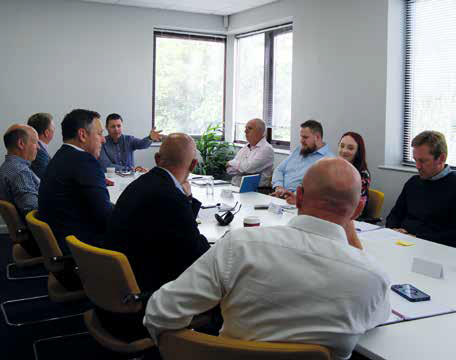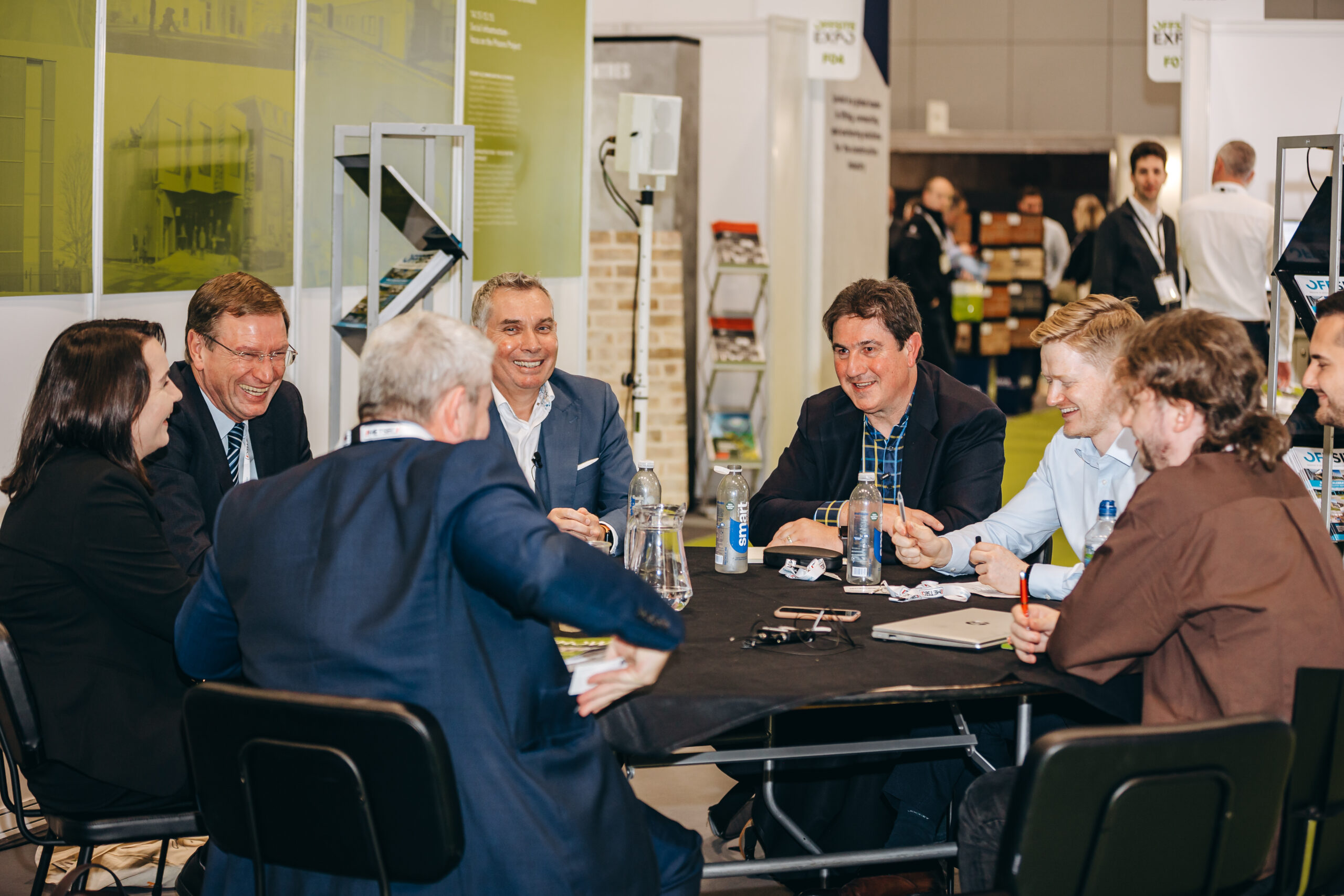
At a roundtable hosted by Dirk Vennix, Executive Director of BUILDOFFSITE and CIRIA CEO, several of those actively involved in the construction of new prisons discussed recent developments and how offsite methods are increasingly important.
For many, the stereotypical idea of a prison is a Victorian-style fortress of thick brick walls and imposing barred jail cells. But what is the reality when it comes to the construction of modern, 21st century prisons? In the last few years, the Ministry of Justice (MoJ) has launched a series of new and innovative prison projects including the pioneering work at HMP Millsike.
Patrick Kennedy, Interim Head of Technical Standards and Design at the MoJ, outlined the programme of work so far. “The New Prisons Programme is all driven by demand pressures, everybody will have seen in the news that we’re almost at that limit,” said Patrick. “To date on the programme, we have delivered two new prisons, HMP Five Wells and HMP Fosse Way. The remaining prisons will follow the same model, so we’ll be using a reference design and delivering that across the New Prisons Programme. The focus on that programme is all around rehabilitation, trying to make it a more normalised environment to better focus on the rehabilitation of prisoners. The latest one, HMP Millsike, is due to be completed in early 2025 and that’s going to be our first all-electric prison.”
Adopting digital technology
One of the key aspects of the New Prisons Programme has been the implementation of digital technology. While modern methods of construction (MMC) are notable for their manufacturing and construction innovations, further efficiencies using digital design have become just as important.
Rebecca Boundy, Public Sector Director at Kier, explained: “From our perspective, you can’t accelerate construction with MMC if you don’t accelerate and continually increase what you do digitally as well. At HMP Millsike and our further programmes we’re now using component tracking. The MoJ were a huge advocate and really encouraged us to innovate and do that as well, because it gives real time identification of where any components are. We’re talking about 1,500 precast panels and probably 30,000 sub-components on one of these large projects, so if you can provide that real time programme, that’s really powerful data.”
Steve Newman, Regional Design Director of Major Projects at Wates, agrees: “The way we have used digitisation in the co-ordination of the designs with our supply chain has been very helpful as well. Often the supply chain is a little bit behind the curve on a lot of that. Investing that time in building the co-ordinated model has definitely been useful in getting better prices from the supply chain but also getting them to understand how the installation is going to work.”
Precast concrete and decarbonised design
Reducing embodied carbon was also a key objective across the New Prisons Programme. “It’s been a big driver for us, reducing our embodied carbon,” said Patrick Kennedy. “In the past a lot of the focus, was around operational carbon, and embodied carbon used to not make up as big a portion of the total carbon footprint as it does today. Because we’ve whittled down the operational carbon, HMP Millsike is around 70% more efficient than Wormwood Scrubs or one of our old Victorian prisons.”
Reducing the embodied carbon of concrete is a challenge the MoJ are currently addressing collaboratively within their supply chain. But examining and questioning historic standards has also helped reduce the amount of concrete used on a project, including something as simple as decreasing the thickness of the prison walls.
“It’s an area that we’re continually challenging ourselves on,” added Patrick. “Historically our standards have said that a reinforced concrete wall needs to be a prescribed thickness. It’s one of these things that’s remained as standard over time, and no one has ever really challenged it.” By challenging the standard, and accounting for the controlled environment of the pre-casting process, the MoJ has been able to reduce the thickness of the pre-cast concrete elements used in the new prisons whilst still achieving the same security performance. Patrick went on to explain that by basing their requirements on ability to achieve the required security rating, rather than being prescriptive, they can lower barriers to innovation and to the supply chain.
The all-important pipeline of work
A central issue across all aspects of the offsite construction world is the need for a constant pipeline of work. A consistent project and factory workflow provides business stability, client confidence and long-term profitability. Steve Newman believed that the government could potentially do more to support offsite manufacturers, by creating this consistent pipeline of work.
“Looking across all of the government departments and trying to find a way to leverage the requirements, most of the big manufacturers are fairly agnostic about what they build,” Steve explained. “The biggest challenge they have is downtime in the factories. If the Government could leverage that supply and that pipeline and say: ‘we’re going to do a lot of prisons for a while’, but then after that, ‘we’re going to do a lot of hospitals’, your factory is going to be full for all that. At the moment we pay more for precast concrete because we pay for the downtime, as well as the actual fabrication. If you could get rid of the downtime, maybe the prices could come down.”
Dirk Vennix asked the panel whether enough was being done to ensure the supply chain was clear and consistent enough across the Government’s various departments. Philippe Sauvageot, Associate Director of Architecture at Mace, explained that the MoJ had been doing a lot of work with its supply chain, including looking at the pipeline and demand around critical products and components.
“When we started the new capacity programme back in 2015-2016, there were some initial estimations around supply and demand around core components,” said Philippe. “That has matured to where the MoJ is now actively monitoring on a month-by-month basis and able to adjust that forward look, based on data and input from the supply chain. I think we have seen some benefits in terms of being able to leverage bulk buying across programmes as well to drive efficiency. It also gives some of those Tier 2 and Tier 3 suppliers the confidence that they have got that demand of supply.”
Providing social value
An essential aspect of the justice system is of course prisoner rehabilitation, and this has been a key aspect of the New Prisons Programme. Members of the panel explained how prisoners have been involved in the construction of the new prisons and have gone on to obtain jobs with the principal contractors on release. “I think one very positive thing that has come out of the New Prisons Programme has been the contractors being able to employ prisoners and help in their rehabilitation,” said Philippe. “In addition to that, working with prison industries and providing purposeful activity, there are members of the supply chain that have been able to provide employment within MoJ workshops for the prisoners.”
Finishing the discussion, Patrick outlined how many former prisoners were now employed by contractors after helping to build the new prisons while on release on temporary licence (ROTL), saying: “Our initial stats suggest that 70% of them have then gone on to get employment with their contractors when they’ve left prison, which is higher than the average rate of people leaving prison and going straight into employment. That’s how you help to stop people reoffending. Make sure they have something to do which helps their rehabilitation process.”
Thanks to all the participants that took part:
- Facilitator: Dirk Vennix, Executive Director, BUILDOFFSITE
- Patrick Kennedy, Interim Head of Technical Standards and Design, Ministry of Justice
- Matt Scard, Digital Lead, Ministry of Justice
- Rebecca Boundy, Public Sector Director, Kier
- Steve Newman, Regional Design Director of Major Projects, Wates
- Philippe Sauvageot, Associate Director of Architecture, Mace
- Steve Lennon, Head of Justice & Emergency Services, HLM Architects
For more information visit: www.buildoffsite.com
HMP Millsike
HMP Millsike will be the UK’s first ‘all-electric’ prison. The new prison – opening in Spring 2025 – will hold nearly 1,500 prisoners with the site set to be the first prison in the UK to run solely on electricity, with solar panels and heat pump technology meaning it will use 78% less energy than HMP Wormwood Scrubs – a traditional Victorian prison – cutting energy costs to taxpayers by over £1.1million a year. The building project is also set to boost jobs in East Yorkshire, with a quarter of those working on the build and 40% of the construction spend falling within 50 miles.
Set to provide almost 1,500 additional prison places, the project will use 14,550 precast concrete components and circa 90,000 subcomponents manufactured across nine factories. Appointed by lead contractor, Kier, PCE Ltd were appointed superstructure and façade delivery partner for HMP Millsike, a category C prison. PCE’s Secure Prison system’s ‘Kit of Parts’ used for HMP Millsike includes sandwich panels, internal walls, circular columns, square columns, floor units, parapet walls, ground beams, steel composite beams, and stair and landing units.
These units are comprised of a hybrid of reinforced concrete and steel, creating a true hybrid superstructure. Throughout the design phase, M&E integrations were diligently coordinated within components through detailed model coordination. Clash detection then helped identify and resolve any issues early on, ensuring components issued for manufacture were of the highest quality and accuracy. PCE’s structural solution was completed 25% faster than the target period.
The plan is for HMP Millsike to operate as zero-carbon in the future, with an all-electric design, solar panels, heat pumps and more efficient lighting systems to reduce energy demand significantly. The new buildings will sit adjacent to the existing HMP Full Sutton and is part of the Government’s plan to create thousands of new prison places.
For more information visit: www.kier.co.uk www.pceltd.co.uk
Read Offsite Magazine Issue 46 in full here