The data centre sector is experiencing exponential growth globally as new technologies, increasingly driven by artificial intelligence and machine learning, demand a significant increase in capacity. How does precast concrete fit into this shift?
The pace of development for these technologies is so rapid that time is of the essence. A failure to meet the urgent demand for data centres could hold back businesses and stifle the UK’s economic growth. This underscores the crucial role of data centre developers, engineers, architects, and industry stakeholders in ensuring the timely construction of these facilities. Offsite manufactured precast concrete is playing a major role in helping to overcome the construction challenges facing this sector, ensuring that the UK does not fall behind in this technology race.
Thermal mass to regulate internal temperatures
Data centres are critical to modern life. They are buildings containing banks of computers that power everything from the internet, AI, cryptocurrency, and streaming to our data storage cloud services. Concrete, being a dense material, possesses a property known as ‘thermal mass’. This means it can absorb and store a significant amount of heat, which helps maintain a stable temperature inside the building. This not only reduces the need for artificial cooling systems but also saves energy and improves comfort.
Optimisation for fast-track construction
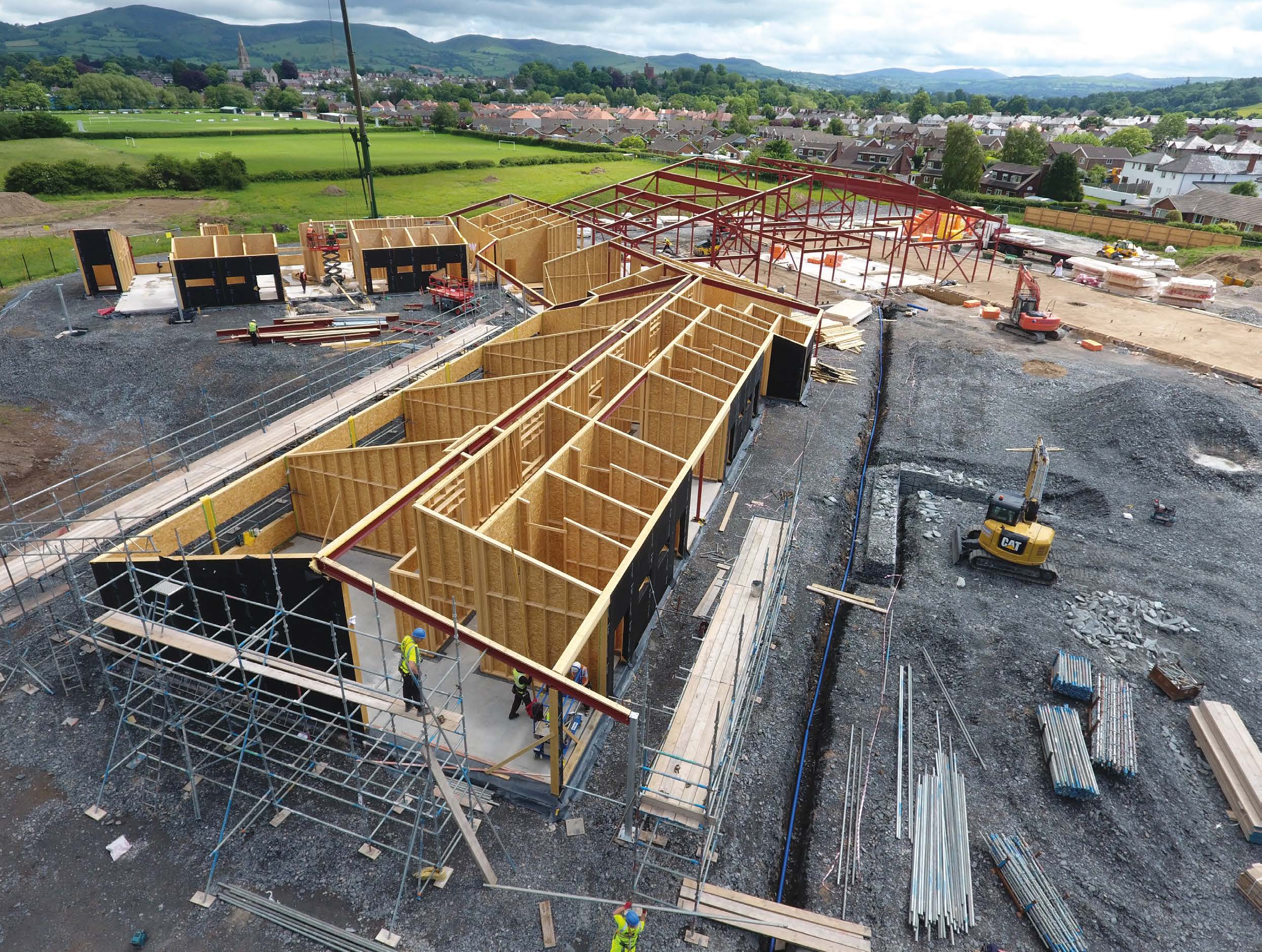
Precast concrete was one of the original modern methods of construction (MMC), long before the term was coined. Hence, FP McCann undertakes numerous Design for Manufacture and Assembly (DfMA) projects across the UK and Ireland, including data centre construction.
Products are manufactured in a factory environment, where quality consistency can be carefully maintained, and then delivered to the site for installation. This process can complete projects 25% to 50% quicker than traditional building methods. The speed of construction can be maximised by choosing precast concrete solutions for key building elements, such as lift shafts and walling, as well as for the primary structural framing.
Standardised and customisable precast components also enhance the efficiency and scalability of data centres, and modular precast designs are beneficial in enabling the future expansion of data centres. Additionally, choosing precast can also mean reduced disruption to the site and surrounding areas, as fewer delivery vehicles may be needed to transport construction products to the site. This is also a sustainability benefit.
Easing the skills shortage
Another significant benefit of precast products being made offsite is that they can be assembled with relative ease on-site. Using precast concrete instead of other approaches, such as brick and block or metal cladding and roofing, reduces the number of trades needed on-site. This is a significant advantage given the national skills shortage affecting the construction industry.
High security and fire safety
Given the critically important, high profile role data centres play in our national infrastructure, they are a target for terrorism – hence their design requires sandwich cladding from the ground to a height of 3.5m. Precast walling can be used here to provide a high-strength solution that is robust enough to resist the impact of such attacks.
Precast concrete also offers a high level of resistance to fire compared to other materials. This is a critical consideration for data centres, given the presence of extensive electrical equipment and networked systems. FP McCann can even cast conduits into the precast concrete floor and roof products to reduce reliance on plastic conduits, which are more vulnerable to fire.
Structural and load-bearing benefits to accommodate heavy loads
The strength of precast concrete is also more suitable for accommodating the weight of the technology packed into data centres. Choosing precast concrete flooring, such as beam and block or hollowcore planks, is very effective at accommodating heavy equipment loads, raised access floors, and cooling systems, among other structural objectives. Precast flooring panels can also span significantly further than many other materials, which can result in fewer structural columns being needed. This increases the versatility of internal spaces, allowing them to be reconfigured more efficiently throughout the data centre’s operational life.
A sustainable material choice
The sustainability credentials of precast concrete also enable developers to meet stringent targets related to embodied carbon and whole-life carbon emissions, aligning with globally recognised sustainable building standards such as BREEAM and LEED. The processes used by FP McCann for manufacturing, for example, are designed to optimise resource and energy efficiency, including through recovery and recycling initiatives. The result is a product with an exceptionally long lifespan, manufactured most efficiently.
In addition, FP McCann’s design team is accredited to BIM Level 2. By integrating BIM throughout the design and construction process, they can support carbon footprint analysis and material optimisation.
How FP McCann supports data centre developers, engineers and architects
FP McCann’s in-house designers are highly experienced, skilled and resourced to add significant value throughout the design and construction of data centres. The broader FP McCann team is structured to deliver comprehensive end-to-end design and engineering support, providing assistance from early concept design to installation, to ensure seamless project execution. For example, custom detailing can be developed for complex layouts and equipment-heavy zones, and real-time updates to models can be done to accommodate late-stage design changes. It all adds up to a more efficient construction process, enabling the rapid delivery of data centres.
For more information visit: www.fpmccann.co.uk