Airtightness in Modern Methods of Construction (MMC) is defined by junction performance, not just the flat surfaces, so independently certified, self-adhered systems are required to offer a reliable route to consistent and repeatable results.
MMC place different demands on the building envelope. Factory-manufactured, rapid installation, and reduced on-site tolerance for rework mean airtightness must be secured through design and detailing rather than corrected later. Continuity at interfaces has therefore become a defining factor in overall envelope reliability.
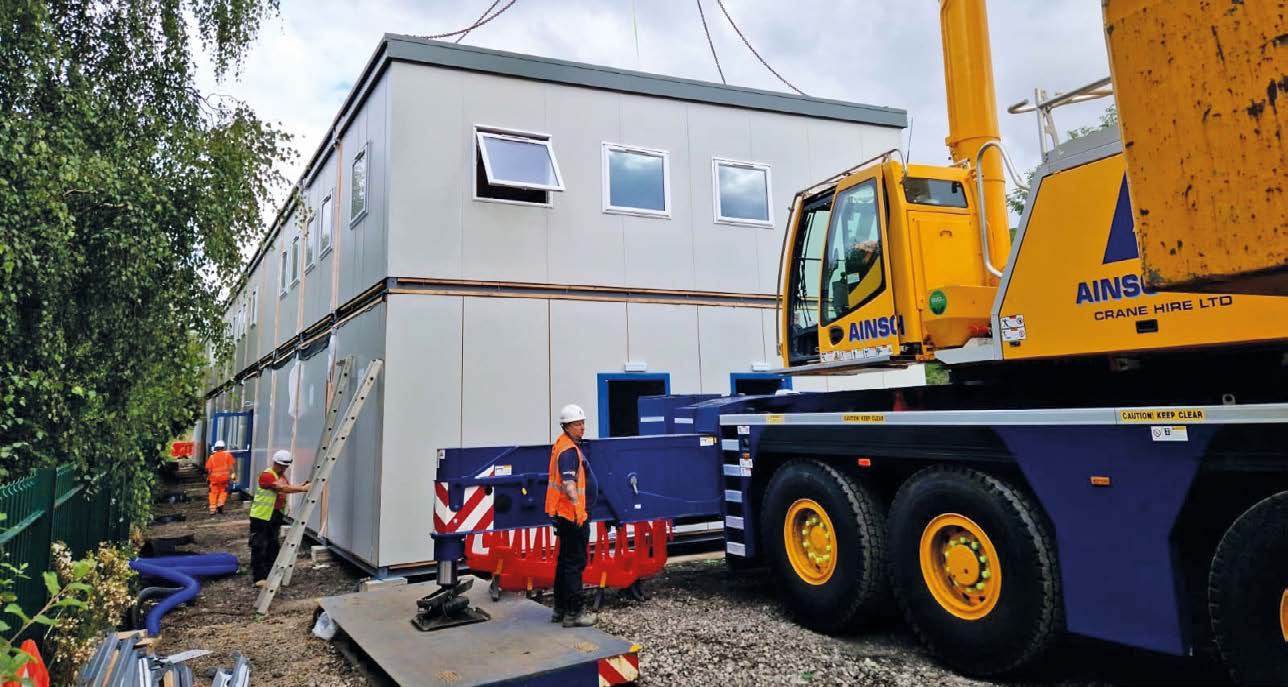
In modular and offsite construction, airtightness failures rarely occur across large surface areas. They occur at interfaces, around openings, between modules, and at floor-to-wall connections. These locations represent the most common points of risk and the greatest challenge to maintaining a continuous air barrier. As a result, selfadhered external air barrier systems are increasingly being specified to address this challenge.
ProshieldR, developed by Don & Low, is a self-adhesive, vapour-permeable airtight membrane designed for use in modular, high-rise and offsite construction. By forming a continuous, self-adhered layer across walls and floors, ProshieldR reduces reliance on secondary sealing methods and minimises the potential for air leakage at critical interfaces. As Mark Gray Technical Manager of Don & Low, Construction points out: “As MMC scales up, airtightness must be proven, not assumed.”
Third-party assurance is a key consideration for MMC projects. ProshieldR is independently certified by KIWA, providing verification of its airtightness, water resistance, vapour permeability and reaction-to-fire performance. This independent certification gives designers, contractors and warranty providers confidence that consistent specified performance is supported by testing, rather than assumed through design intent alone.
Fire performance is an increasingly important factor in external wall buildups. When applied to suitable substrates, including fibre cement boards, ProshieldR achieves a Class B-s1,d0 reaction-to-fire classification in accordance with BS EN 13501-1. As with all membrane systems, fire performance is substrate-dependent and correct specification remains essential.
Installation efficiency is another critical requirement in MMC environments. ProshieldR requires no primers, mechanical fixings or additional air-sealing layers. Its peel-and-stick application supports fast, repeatable installation in factory settings and on-site, helping to reduce sequencing complexity and installation variability. A printed alignment grid aids accurate positioning, while a full range of compatible tapes and preformed corners enables secure detailing around windows, doors and junctions.
MMC is increasingly judged on proven outcomes rather than theoretical performance. Airtightness strategies must be reliable in real-world conditions and consistently deliverable at scale. Self-adhered, independently certified systems provide a reliable route to achieving airtightness where it matters most, in the details.