Paul Ruddick, Chairman of Reds10, spoke to us about booming business and why the volumetric modular sector is perfectly placed to provide a new generation of low carbon, energy efficient buildings.
Q: Can you outline the creation of Reds10 and its overarching role amongst the many others attempting to disrupt the construction model?
Paul Ruddick (PR): We started Reds10 with a definite aim in mind: to be a game changer. We wanted Reds10 to have an impact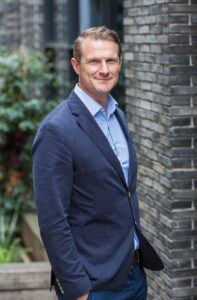 on the industry from the start, because we recognised that the traditional construction business model has not generated any improvement in productivity in the last 50 years. This is not through a lack of great people in our industry but rather that the business model has not evolved. We recognised that centralisation was the answer. By having our own design capability, vertically integrated in-house supply chain, offsite manufacturing capabilities and great on-site delivery, we could generate higher levels of productivity. Clients want to have a building finished to a high standard, on time, on budget and they want a single point of responsibility to make it happen.
Q: The ‘traditional’ way of construction is portrayed as outdated but still has a giant market share – can offsite delivery, DfMA and factory-based methods really deliver a lasting alternative?
PR: Considering market conditions, the construction industry will have no other choice but to fully embrace some form of offsite methods in the not-so-distant future. However, expecting a jump in productivity by shifting part of the construction process into a factory, while keeping the current traditional contracting business model, will not happen. Increased use of platform design, standardised design and sub-assembly components will naturally drive demand for factory-based methods in the future and they are what will have the biggest lasting impact.
Q: How integral to the future of volumetric modular methods is the deeper understanding and use of digital tools and technology – or AI – to develop more efficient new buildings and increase quality/productivity levels – how is Reds10 developing an Industry 4.0 approach?
PR: Construction has no alternative but to embrace digital tools and technology if it is going to progress. The tools available must be adopted across the industry regardless of position, age or discipline. This is how Reds10 operates – you’ll often hear us saying that we are ‘born digital’. We now have the capability to track and (more importantly) analyse and measure productivity and activity across the business against key metrics. This means we can make key business decisions based on data that is trusted. This is the only route to gains in productivity. On a wider level, the widespread adoption of technology – specifically shared data and information throughout the construction process and beyond – allows the industry to be less siloed, but ultimately drives greater accuracy, efficiency, productivity and safety.
Q: Can you say a little about the Thrive™ SMART building technology? What does this deliver across your projects to help provide accurate energy consumption data? Can it help boost pre-manufactured value?
PR: Thrive™ is our proprietary SMART building system, which is built into our units and accessed via a single platform. The system generates and analyses data points covering humidity, door and window contacts, sound levels, temperature, daylight, power metering, water and more. In a recently completed Imjin Barracks project, the system is generating and analysing over 21,000 data points. To give you an idea of scale, a typical Class A Building System works with approximately 220 data points.
Having an integrated business model plays to the installation of SMART systems. Generally, several systems are installed that don’t talk to each other. But we design everything ourselves in-house and install as a single system that allows all the hardware, like the air-source heat pumps and mechanical ventilation and heat recovery systems, to talk to each other. We then overlay that with code, so it responds to an occupant’s behaviour. When someone is in a bedroom, for example, and they open the window, it turns off all the heating in that room.
Q: Education is a key area for Reds10, and the recent completion of Imjin Barracks for the Defence Infrastructure Organisation (DIO) and British Army is a landmark moment – have public sector clients got a clearer understanding of what procuring an offsite solution brings or is there still a knowledge gap?
PR: Yes, education has always been a key sector for Reds10, but we now work across the Defence and Justice sectors, which are just as important for us. There is of course still a knowledge gap but personally, I believe it’s not the client’s job to become an expert in offsite construction and its benefits. What they want is a high-quality building, in the shortest timescale, at the best value, with the lowest carbon. It’s up to us, the experts, to give them confidence that offsite construction is the way to achieve all these goals better than other building types. This is all part of the customer experience at Reds10, we are offering the best solution for the clients’ requirements, and we are working together to do so.
Q: Building regulations, the planning process and warranty issues often stymie some of the benefits of offsite – e.g. its speed. What can be done to improve this situation and widen its client appeal?
PR: In my opinion, so many of the recent failures in the offsite market have been down to companies putting all their eggs in one market: the private residential sector. I believe that a standardised product, so that units can be relocated to other sites in the event of planning or on-site delays alongside a strong pipeline of work across different sectors to lessen pipeline risk is the answer here. In fact, a Bryden Wood report has shown that 70% of the public sector estate could be delivered via one product. Should the industry come on board with this, it would reduce the number of technical variables and requirements, which would inherently streamline technical compliance. This would go a long way in allaying the current potential client worries.
Q: Carbon reduction is central to everything we do in society, but there is an additional focus on understanding embodied and operational carbon more in construction. How is Reds10 delivering its projects with sustainability issues and net zero targets in mind?
PR: Reds10 has been delivering amazing spaces with less carbon for several years now – this includes schools for the DfE, accommodation for the MoD, leisure spaces for local council and more. We’ve been able to do so primarily through the extensive knowledge of our entire team, starting at procurement stage and flowing right through to operating the finished building through our Thrive™ SMART building system.
It should be mentioned that offsite construction is inherently lower in carbon than traditional construction, especially when achieving a high pre-manufactured value. However, what has really helped us achieve some impressive milestones, is a collaborative working environment throughout each project team, which includes the client and key stakeholders. Getting everyone on the same page and working together towards a common goal, alongside the ability to implement user feedback and lessons learned from completed buildings directly back into the design and production of the next building, at speed, has allowed us to ensure the highest of sustainability outcomes.
Q: 2023 was a torrid year for the volumetric sector with some significant business exiting for a variety of reasons. Reds10 delivered strong financial performance and a third consecutive year of turnover and profit growth – what do you attribute this success to?
PR: I believe that some of the decisions we made four years ago have put us in a great position today. Namely, we were early adopters of platform design, while also centralising our design capabilities and taking them in house. Perhaps most importantly, we placed our design and technical directors at the centre of the business, while tasking them specifically with a focus on research and development.
We invest significantly to develop and deploy new technologies that help to improve end user experience and building quality. Last year was another period of high performance and achievement as Reds10 continued its consecutive year-on-year growth trajectory, bucking the market trend despite wider challenges. Our strong secured pipeline of work is testament to our focus on innovating products that are tailored to meeting customers’ needs, our unique platform approach, vertically integrated delivery, an ongoing commitment to product innovation and in-house design capabilities.
Q: How do you see the volumetric modular offsite and wider offsite sector developing over the next 18 months and what ideally do you want to see from a Reds10 perspective in 2024?
PR: I truly believe volumetric offsite construction is going to break into the mainstream in the next 18 months. Not least thanks to the complex, high-quality buildings Reds10 has recently delivered, which clearly and undeniably demonstrate the benefits of offsite construction. Thanks to our portfolio of work, we are now being awarded larger, more complex projects, which directly contradicts the argument repeatedly given by Tier 1 contractors – that modular specialists cannot deliver large, complex projects. We are just about to open our fifth factory in Driffield, East Yorkshire, and have a virtually full order book.
For more information visit: www.reds10.com You can also catch Paul Ruddick on 20 March at Modular Matters, Coventry Building Society Arena