Mollie Claypool, Co-founder and CEO of AUAR, sets out the case for deployable micro-factories backed by construction-specific Physical AI that can provide high-quality, sustainable timber homes quickly and confidently.
Housing is built at an enormous scale, continuously. In the United States alone, roughly one to one and a half million residential units are under construction at any given time (U.S. Census Bureau, Monthly New Residential Construction, December 2025). Across the UK and EU combined, official data suggests the figure is roughly two million. This is a live system under strain.
Demand for housing continues to rise as labour availability declines. Delivery has remained structurally unchanged for decades: design, supply chains, manufacturing and site execution still operate in silos, with limited continuity from one build to the next. Timelines stretch, costs escalate and quality varies. What the sector lacks is a delivery system that reliably translates high-performance design into built reality at scale, under real-world constraints, without forcing builders to reorganise their operations.
The problem with traditional factories
Significant investment has flowed into offsite manufacturing. Large, centralised factories promise industrialised housing production, but many models demand heavy upfront capital, fixed infrastructure and long-term volume certainty. They serve a narrow segment of the market – operators who can guarantee enough throughput to justify the investment.
Most homebuilders work with variable pipelines, site-specific constraints and evolving programmes. They cannot commit to the volumes that make a fixed factory viable, and they cannot afford idle machinery on their balance sheets when market conditions shift. The limiting factor is not intent – it is risk. For housing production to scale and respond to demand, capacity must adapt to industry realities rather than forcing the industry to adapt.
The on-site micro-factory model
On-site micro-factories change the equation by distributing manufacturing capability to building sites, or close to the projects they serve.
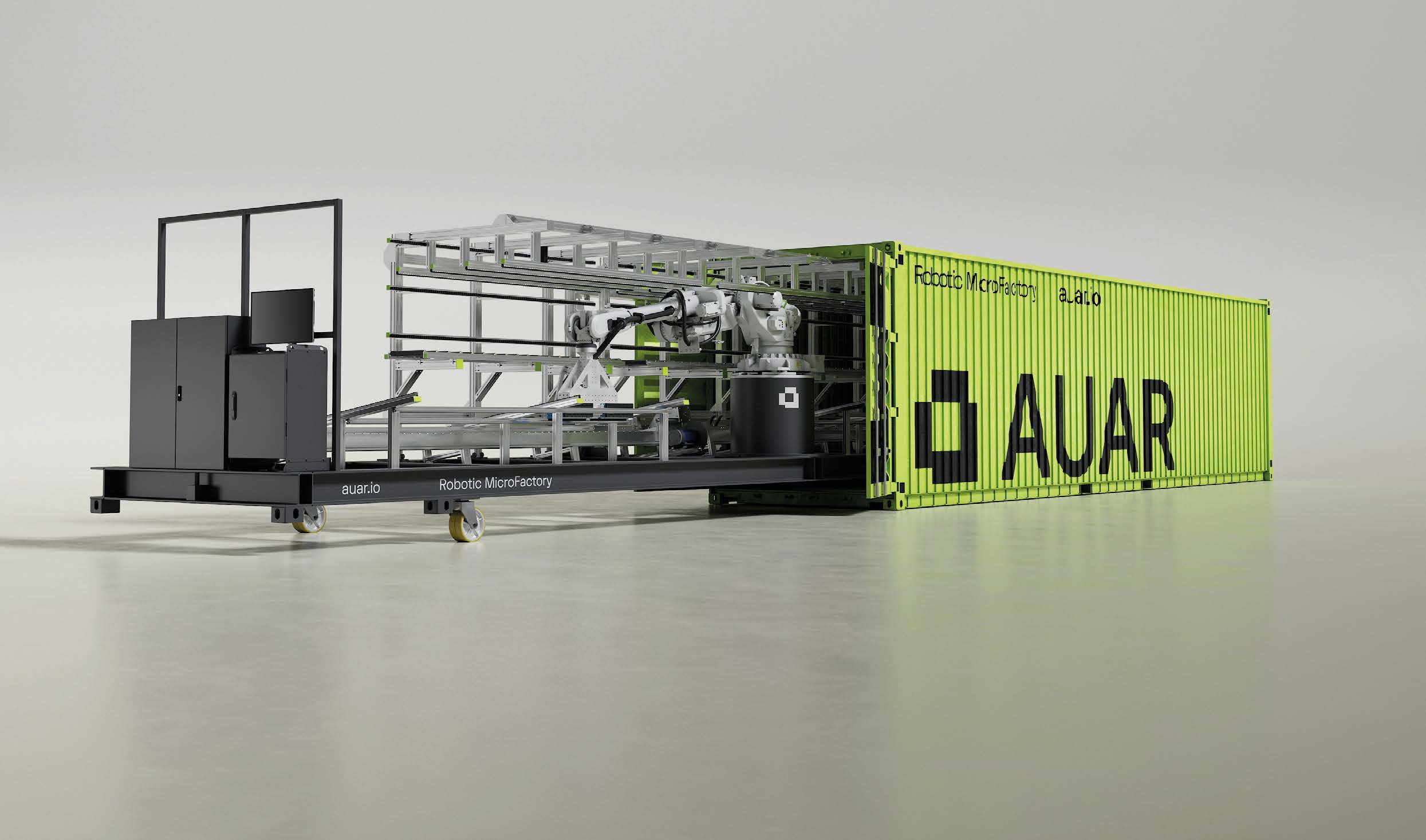
AUAR’s micro-factory is a deployable, robotic production unit that fits inside a standard 40-foot shipping container. It can be transported to site, deployed in half a day, and begin producing timber frame wall panels, floor cassettes, and simple roof elements using standard timber. It is a turnkey system: plug in three-phase power or a diesel generator, and it is ready to run.
The implications are practical. Raw materials are delivered to the point of production, reducing longdistance transport and the coordination burden of remote factory supply. The micro-factory produces what the project needs, where it needs it, when it needs it. For a typical house, that can mean the core and shell produced in under eight hours.
Critically, the micro-factory is charged on usage, not purchased. Partners access manufacturing capacity only when they need it and pay per square metre of panel produced. When production pauses, costs stop. There is no capital expenditure, no idle machinery and no long-term volume commitment. The financial risk that makes traditional factory automation inaccessible to most builders does not apply.
Construction needs domain-specific Physical AI
The gap between architectural design and factory-ready manufacturing files has historically required large teams, manual redrawing, and weeks of coordination. AUAR’s MasterBuilder Physical AI software closes that gap.
MasterBuilder translates a building design into a production-ready package in under a day: drawings, material take-offs and robotic manufacturing files. It automates design-for-manufacture logic, adapts models to required structural sizing in line with building codes, and outputs IFC for delivery teams. Once a typology is set up, it can be reused across projects with changes made near-instantaneously.
MasterBuilder uses vision and sensors to get live feedback and translate manufacturing intent into reliable decisions on real timber, where materials are not uniform. Timber arrives with variability in moisture, bow, twist, knots, and tolerances. AUAR’s control layer detects and compensates in-line. It adjusts clamping, toolpaths, and cut strategies. It flags out-of-spec inputs and learns from outcomes across deployments. The result is repeatable production from imperfect materials, with remote diagnostics and improvements propagated to every unit. This is Physical AI for homebuilding.
To unlock adoption, AUAR field operators embed with partners to launch each micro-factory and run production. They are accountable for throughput, quality, and uptime. This is not just support. It is the operating model for bringing on-site automation to homebuilding. It removes execution risk, shortens time to first output, and locks in output quality while partners build internal capability to scale.
Why AUAR’s operating model matters
AUAR was founded on a premise tested over more than a decade: manufacturing capacity should meet builders and projects where they are. The technology is designed to integrate into existing delivery models rather than replace them. Partners continue using familiar materials, suppliers, and workflows. Automation is introduced incrementally, sized to real building programmes, and scaled as confidence and demand grow.
For homebuilders, this means turning every site into a factory – deploying manufacturing capacity directly where homes are being built, with no upfront investment and no operational overhaul. For manufacturers and component suppliers, it means high-mix, high-flex production at zero capital expenditure – micro-factories can operate within existing facilities or be deployed to customer sites, switching between products and projects. In AUAR’s view, the micro-factory model trades fixed-line efficiencies for far greater adaptability and can improve throughput where the constraint is variability, not raw cycle time.
Behind every deployment is AUAR’s accumulated operational knowledge built across production environments in the US, Canada, UK and EU. Each project contributes data and learning that is formalised into repeatable processes, improving outcomes for partners over time. The housing industry needs production systems that are as distributed, adaptable, and continuous as the demand they serve. Micro-factories are one credible route to distributed capacity at scale. AUAR’s bet is that deployment plus operating model – not just hardware – is what makes it stick.