How is offsite manufacture and industrialised construction reshaping design leadership, systems thinking and the role of the architect? A recent roundtable discussion held at Hawkins\Brown brought architects, contractors and offsite specialists together to examine how.
Much talk surrounds how manufacturing-led delivery is not just changing how construction happens and how buildings are delivered, but how they are procured, specified, designed, co-ordinated and delivered. What is the future role of the architect in all of this?
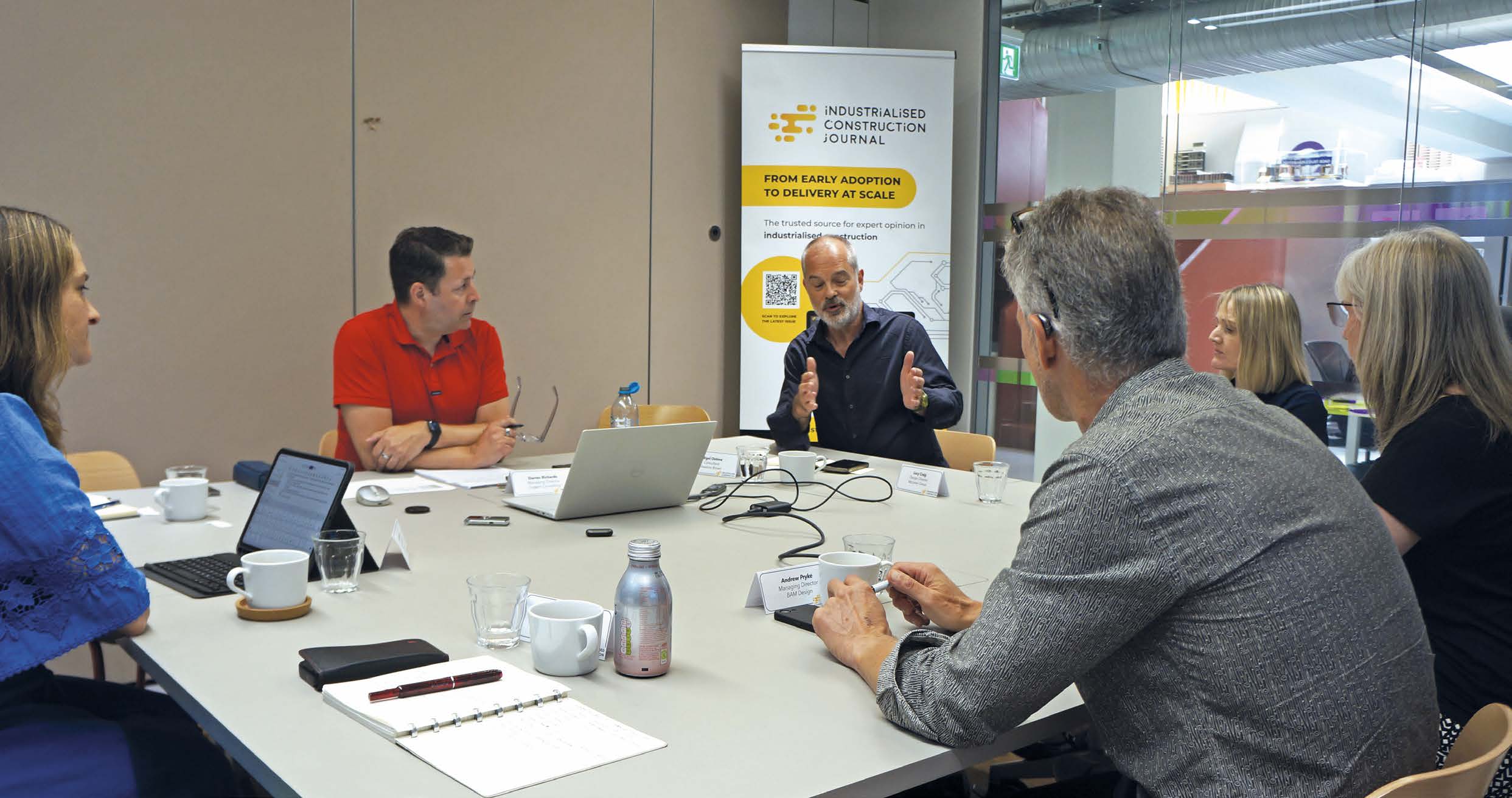
That central point sat at the centre of a recent roundtable hosted by Hawkins\Brown in London, where architects, contractors and offsite and industrialised construction specialists debated one of the sector’s most significant transitions – the move from bespoke, projectled design towards manufacturing-led systems and how innovative design fits into the equation.
Design is changing not just delivery
One of the sharpest questions raised during the session was whether architecture has fully accepted what offsite construction demands – not just a different delivery method, but a different design process. Several participants argued that the industry still too often approaches offsite methods retrospectively by designing conventionally, then attempting to apply an industrialised or offsite solution later. For Nigel Ostime, that remains a fundamental barrier. “I think it’s a mindset issue,” he explained. “Unless you genuinely think about industrialised processes from the beginning, you won’t operate in an industrialised construction mindset.”
Anne Daw argued that industrialised approaches are forcing architects to reconnect with the technical realities of construction in ways that traditional procurement models have gradually eroded. “It reconnects us with how we build as architects and makes us more disciplined as designers,” she noted. The point was not that manufacturing-led construction makes design less important. It makes design decisions earlier, more consequential and more tightly connected to delivery.
Bespoke project to configurable systems
A recurring theme was the shift away from bespoke project-by-project thinking towards repeatable systems, configurable platforms and kit-of-parts methodologies. As ever, several attendees drew comparisons with automotive, aerospace and electronics, where configurable product platforms have long replaced one-off assembly. Construction, they argued, is now beginning a similar shift. For architecture, the question is whether standardisation can co-exist with quality, identity and place-making – or whether repeatability inevitably creates uniformity. The consensus was that standardisation and design quality are not opposites. The real question is what should be standardised, and where architectural judgement should remain open.
Suria Jones explained that Laing O’Rourke’s manufacturing-led model is not about eliminating design flexibility. It is about understanding which parts of a building genuinely need customisation, and which can be standardised to improve efficiency and certainty. Rory Bergin made a similar point from HTA’s experience in volumetric residential delivery, arguing that disciplined, repeatable design principles can still support commercially successful and architecturally ambitious projects.
Even where projects do not ultimately adopt full offsite or modular solutions, the discipline still matters. Repeatability, co-ordinated dimensions, rationalised layouts and standardised interfaces all contribute to better buildability, lower risk and greater delivery certainty regardless of final construction methodology.
The architect as a systems integrator
One of the strongest themes was the changing role of the architect within the offsite and industrialised construction eco-system. Manufacturing-led construction pushes architects beyond form, space and compliance, requiring them to understand components, interfaces, supply chains, digital workflows and assembly logic as one connected system.
Andrew Pryke argued that architects need to reengage with technical coordination, systems integration and project delivery. These are areas where the profession has lost influence through fragmented procurement and ‘design and build’ contracting. Several participants noted that the Building Safety Act may accelerate this shift by increasing expectations around design accountability, co-ordination and systems integration.
The conversation also highlighted how industrialised construction exposes the interconnected nature of modern buildings. Structural systems, facades, MEP services, fire stopping, logistics and assembly sequencing all become tightly linked within manufacturing-led delivery models. Lucy Craig noted that construction already contains multiple “systems”, but too often they operate in silos rather than as an integrated whole. Industrialised construction therefore demands a different kind of design leadership, one focused less on isolated disciplines and more on orchestrating interfaces across the entire building lifecycle.
Procurement a big barrier
However strong the appetite for more offsite delivery and adoption of industrialised construction, the roundtable repeatedly returned to the same constraint: procurement. Offsite construction depends on early decision-making, design certainty, integrated supply chains, upfront co-ordination and long-term collaboration. Yet traditional procurement models often encourage the opposite – late-stage changes, fragmented responsibilities and short-term competitive tendering.
Lucy Craig highlighted how architects and designers are frequently unable to influence delivery strategies early enough because procurement routes, contractor involvement and supply chain decisions often remain unresolved during concept design stages. That creates a structural contradiction – offsite construction needs certainty early, while traditional procurement often preserves optionality until the point where meaningful industrialised design decisions have already been lost.
However, government programmes in justice, health and education as examples where repeatable procurement models are beginning to support standardisation and learning across projects. Several participants warned that frameworks only create value if they close the feedback loop between completed projects and future design iterations. Without that learning, the industry risks repeatedly reinventing systems rather than genuinely ‘industrialising’ them.
Digital threads are becoming critical
Digital design, BIM-to-manufacture workflows and data continuity formed another major theme in the discussion, with participants agreeing that industrialised construction cannot scale without stronger integration between architecture, engineering, manufacturing and onsite assembly.
Andrew Pryke described how the industry is moving beyond conventional BIM towards more sophisticated digital ecosystems involving AI, machine learning, data analytics and smart manufacturing workflows. Yet many contributors felt construction still lags other sectors in its use of data and digital systems. The opportunity is to create a genuine digital thread from concept design through manufacturing, logistics, assembly, operation and long-term performance.
Participants argued that offsite construction creates the conditions necessary for this digital continuity because repeatable systems are inherently easier to model, analyse and optimise, but this must be cautioned against assuming technology can solve structural problems retrospectively. Standardisation, disciplined design and integrated delivery are prerequisites for digital transformation, not outputs that software can create after the event.
Manufacturing constraints are becoming design inputs
The discussion also turned to the practical realities of designing for manufacture. Transport dimensions, lifting limits, tolerances, sequencing and assembly logistics all become design inputs in an industrialised construction environment. Some argued these constraints are often perceived negatively by architects accustomed to greater formal freedom.
Others argued that constraints can drive more rigorous design thinking, as they do in aviation and automotive manufacturing, where innovation happens inside tightly controlled production parameters. Rather than reducing creativity, offsite construction may simply require creativity to operate differently. Constraints only become problematic when introduced too late. Embedded from the outset, they become part of the design logic.
Skills and Costs
Many around the table argued that architecture schools still insufficiently prepare students for manufacturing-led construction environments.
Traditional architectural education often prioritises conceptual exploration over technical co-ordination, systems thinking and buildability. Offsite construction demands a wider skillset tsking in manufacturing literacy, digital co-ordination, logistics awareness, systems engineering and datadriven design. Participants also argued that factory environments, digital workflows and advanced manufacturing processes could help attract a broader workforce into the built environment – particularly as construction continues to face labour shortages, an ageing workforce and weak productivity.
A key talking point surrounded cost. Participants repeatedly warned against reducing industrialised construction to a cost-cutting exercise. The stronger case is value, with programme certainty, productivity, safety, quality, sustainability, workforce wellbeing and risk reduction of greater ultimate importance.
Suria Jones argued passionately that many traditional construction activities simply should not continue in their current form when safer, more controlled manufacturing alternatives exist. Several attendees made the same wider point – the objective is not to move inefficient site processes into factories. It is to redesign the operating model around certainty, quality and repeatability.
Architecture at the centre of transition
By the end of the discussion, there was broad agreement that offsite methods and industrialised construction is no longer a niche conversation. Declining productivity, labour shortages, climate targets, building safety requirements, rising complexity and increasing client expectations are pushing the issue into mainstream practice, even as structural barriers remain around procurement, insurance, education, regulation and cultural resistance.
Perhaps most importantly, the roundtable placed architecture at the centre of the transition. Far from diminishing the role of architects, industrialised construction may expand it. For architects, the opportunity lies in taking a stronger leadership role – integrating systems, technology, manufacturing and design from the outset. But this requires procurement, education and supply chains to evolve alongside the technology. Standardisation need not come at the expense of architectural quality or aesthetics. Instead, it can create the certainty and efficiency that allow creativity to flourish. The challenge is whether clients, procurement models, design teams and supply chains are prepared to evolve quickly enough to make that shift viable. The industry may already know what needs to happen. The harder question is whether it is ready to organise itself around it.
ATTENDEES
Facilitator: Darren Richards, Managing Director, Cogent Consulting
Rory Bergin, Partner, Sustainable Futures, HTA Design
Vincent Bolton, Editor, Industrialised Construction Journal
Suria Jones, Head of Design, Laing O’Rourke
Lucy Craig, Design Director, McLaren Construction Group
Anne Daw, Head of MMC Delivery, HLM Architects
Nigel Ostime, Consultant, Hawkins\Brown
Andrew Pryke, Managing Director, BAM UK & Ireland
TOP TAKEAWAYS
• Industrialised construction changes design, not just delivery – manufacturing-led construction only works when it shapes thinking from the outset – not when MMC is bolted on after a conventional design process.
• The architect’s role is expanding – industrialised construction pushes architects into systems integration, interface management, technical coordination and delivery leadership.
• Standardisation does not mean uniformity – the challenge is not whether to standardise, but what to standardise – and where design judgement, local context and architectural identity should remain open.
• Procurement is still the biggest structural blocker – early certainty, integrated teams and repeatable delivery are essential, but traditional procurement often preserves optionality until the critical decisions have already been lost.
• Design decisions need to move upstream – manufacturing constraints, tolerances, transport, lifting, sequencing and assembly logic must become design inputs from day one.
• The digital thread is now critical infrastructure – industrialised construction cannot scale without stronger data continuity between design, manufacture, logistics, assembly and operation.
• Technology cannot fix poor operating models retrospectively – AI, BIM and digital workflows only deliver value when standardisation, design discipline and integrated delivery are already in place.
• Manufacturing-led delivery needs systems thinking – buildings must be understood as connected systems – structure, facade, MEP, fire strategy, logistics and assembly all must work together.
• Skills and education need to catch up – architecture and construction education must place greater emphasis on DfMA, manufacturing literacy, digital coordination, logistics and buildability.
• The value case is bigger than cost – the strongest case for industrialised construction is certainty, quality, productivity, safety, sustainability and risk reduction – not simply cheaper delivery.