The UK construction industry faces inflation, higher costs, complex planning, compliance challenges, and many supply chain issues. But as Jackie Maginnis, Chief Executive at the MPBA suggests, volumetric modular construction is becoming a strategic answer to these uncertainties.
VOLUMETRIC MODULAR TECHNOLOGY offers a level of certainty and control that traditional construction struggles to achieve. As regulatory frameworks become more demanding, delivering buildings that meet standards for fire safety, energy efficiency, accessibility, and overall performance requires precision and consistency. Offsite factory production allows these requirements to be embedded from the outset. Quality assurance becomes systematic rather than reactive, with inspection, testing, and certification integrated into production workflows. An industrialised construction approach integrating digital design and advanced automative manufacturing results in component traceability further strengthen accountability, giving clients and regulators confidence that what is designed is exactly what is delivered.
Certainty and control
The repeatable nature of volumetric systems also enables earlier, more productive engagement with building control bodies and other stakeholders. In healthcare and education, where ventilation, acoustics, infection control, and safeguarding requirements are exacting, the ability to refine and approve standardised classrooms or ward types for deployment across multiple sites streamlines approvals and reduces regulatory uncertainty. Compliance is designed in, rather than managed as a series of site-based challenges.
The financial case for volumetric construction has never been stronger. Factory manufacturing provides far greater cost certainty, shielding projects from the short-term volatility that can affect onsite labour and material procurement. Long-term supply agreements, controlled production processes, and a stable, directly employed workforce reduce exposure to inflationary swings. Modular manufacturers operating across multiple projects can also aggregate demand, further insulating against price fluctuations that would otherwise impact individual projects.
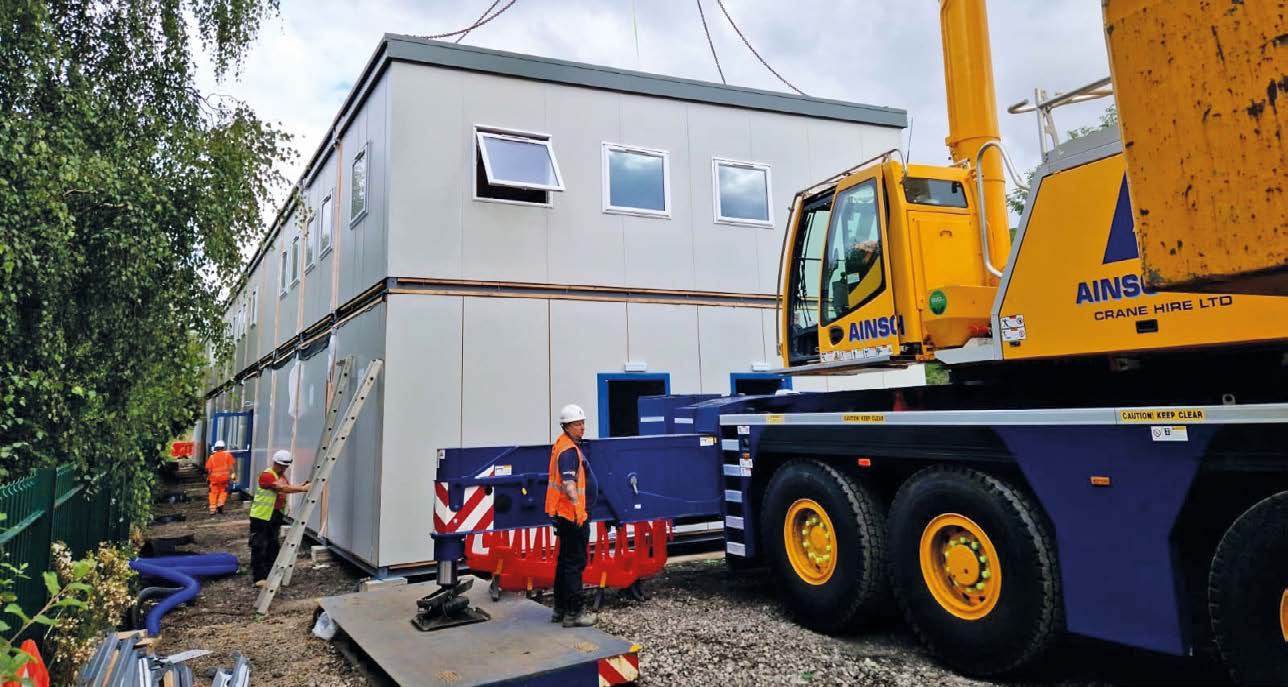
Programme compression is another key advantage. Volumetric construction allows site preparation and building manufacture to run concurrently, significantly shortening overall delivery times. For public sector clients in healthcare and education, this means earlier access to essential facilities and reduced reliance on temporary accommodation. For commercial developers in office, retail, and leisure sectors, it translates into faster occupation and earlier revenue generation. In every case, shorter programmes reduce exposure to inflation and lower the risk of cost escalation during prolonged construction phases.
Providing a sharper focus
Higher financial overheads have sharpened the focus on the cost of time. The longer a project remains on-site, the longer capital is tied up servicing debt. By accelerating the path to completion, volumetric construction reduces financing costs while mitigating the risk of on-site disruption, weather delays, and programme overruns. Predictable schedules and lower risk profiles can also improve funder confidence and support more robust financial modelling when viability margins are under pressure. Supply chain resilience is another strength. Traditional construction relies on complex, fragmented networks feeding labour and materials into sites on a just-in-time basis – a model highly vulnerable to global disruption, transport delays and material shortages. Volumetric manufacturers consolidate supply chains within controlled production facilities, allowing procurement to be planned in advance, key components to be stockbuffered, and logistics tightly co-ordinated.
Advantages across non-domestic sectors
These benefits are particularly significant in the non-domestic sectors that MPBA members serve. In healthcare, volumetric construction enables the rapid delivery of high-specification clinical environments, from wards to diagnostic suites, where performance and hygiene standards are critical. In education, repeatable classroom and specialist teaching modules can be deployed with minimal disruption to term times, while maintaining high thermal and acoustic performance. In commercial settings, modular approaches allow faster fit-out, flexible reconfiguration, and reduced void periods – all crucial in a market where occupier needs continue to evolve.
These factors position volumetric modular construction as a practical response to the intertwined challenges of regulation, cost and risk. By shifting much of the construction process into a controlled manufacturing environment and enabling parallel working, it enhances predictability, shortens delivery times and strengthens resilience. In a climate where uncertainty is one of the greatest threats to project viability, the combination of speed, quality and certainty is not just enticing – I believe it is increasingly essential.
MPBA
The Modular and Portable Building Association (MPBA) is the UK’s leading trade body representing the sector. It promotes best practice, quality standards and innovation across the industry, supporting architects, engineers, manufacturers and supply chain partners. Through advocacy, training and guidance, the MPBA advances the sector’s growth, sustainability and professional standards – ensuring safe, efficient and high-quality solutions for those who work, receive treatment, teach and learn in modular buildings.