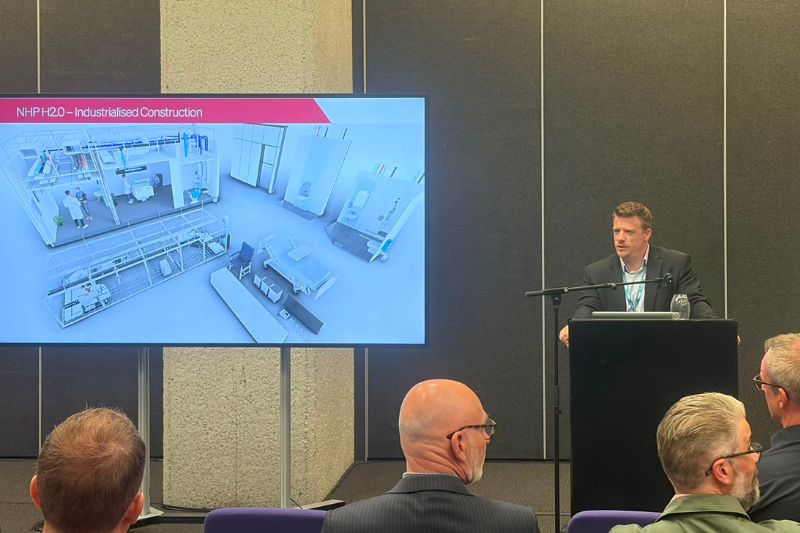
The New Hospital Programme (NHP) is preparing to roll out its standardised modular inpatient bedroom.
Off-site construction specialist Reds10 is working alongside the NHP to develop a full-scale prototype of a standardised patient bedroom, en suite and adjoining corridor using modern methods of construction (MMC).
Reds10 believes the project could help accelerate the adoption of digital technology across NHS estates.
Speaking to Building Better Healthcare, Richard Fox, Director at Reds10, said the industry is moving beyond simply discussing AI, automation and smart sensors and towards integrating these technologies into the design, construction and operation of future hospitals.
Fox believes the Hospital 2.0 programme could help make digital twins, smart sensors and AI-powered quality assurance central to both the delivery and long-term management of NHS hospitals.
“I think what we’re going to see in the industry is [a move] from concept and talking about how sensors, AI and automation can help, into it actually being done. That’s certainly been our experience at Reds10, where it’s been part of day-to-day delivery for some time now,” he said.
A return to healthcare
Although Reds10 has delivered healthcare projects in the past, the company stepped away from the sector after finding that projects were too fragmented and bespoke to suit its industrialised construction model, which is based on standardised designs, off-site manufacturing and assembly.
The New Hospital Programme changed that approach.
The NHP has placed a strong emphasis on industrialised construction, Fox said.
“There is now a significant programme pipeline, a drive for standardisation and a commitment to industrialised construction. We thought, ‘Well, it’s time.'”
Rather than immediately returning to the market, Reds10 followed its established product development process, designing, testing and certifying healthcare solutions before taking them to market.
Working with the NHP, the company developed prototype patient rooms using Design for Manufacture and Assembly (DfMA), refining the designs through multiple rounds of clinical testing.
“There were so many decisions that needed to be made that we built the room and the module several times to inform the right decision,” he said.
Rather than focusing solely on manufacturing efficiency, Reds10 worked with the NHP team and clinicians to balance buildability with patient care and staff wellbeing.
“There were a lot of commercial or construction decisions that, on the face of it, seemed like a better answer.
“But working with the clinical team and seeing the testing they were doing to reach the right decisions, that was eye-opening.”
The role of digital twins, sensors and AI
Reds10 believes one of the biggest opportunities presented by Hospital 2.0 extends beyond the construction phase itself.
The company has spent years incorporating smart sensors into buildings, gathering operational data to improve building performance and inform the design of future projects.
However, Fox said the potential within hospitals is considerably greater.
The volume of data generated within a live, operational hospital environment is significantly higher than in many other sectors, he said.
That data could prove highly valuable.
Rather than completing a building and then stepping away, Reds10 envisages future hospitals becoming living digital assets, with digital twins continuously tracking how facilities perform throughout their operational lifespans.
“It is all too often in the world of construction that once you’ve built something and handed the keys over, it gets forgotten,” said Fox.
“There are learnings, maintenance and best use of the buildings.”
Fox said each modular hospital solution comprises tens of thousands of individual components, increasing the importance of AI in managing the complexity involved in design, manufacturing and delivery.
Reds10’s vertically integrated business brings together 12 specialist companies covering areas including steel fabrication, fit-out, land development and furniture, allowing the company to manage this complexity through a single delivery model.
The approach also enables Reds10 to harness the data and lessons generated across its vertically integrated operations.
Smart sensors can provide data on how people move through hospital spaces, highlight maintenance requirements and generate insights that can be used to improve the design of future facilities.
For facilities management teams, the aim is to make this information readily accessible through AI.
“You should be able to speak to the building and ask, ‘Where are the problems? Where is the maintenance schedule? How many people do I need? Create me a plan.’ Simplifying that world is going to be key.”
Fox compared the industry’s transition towards digital twins with the earlier adoption of Building Information Modelling (BIM).
“It was no different to having 2D CAD software into the world of actually using BIM and structuring data. There was a big shift in how that world changed, and this is an even bigger shift.”