For more than 25 years, HLM Architects has been at the forefront of prison design, driven by two key principles: operationally-led design and the reduction of reoffending.
Steven Lennon, Head of Justice & Emergency Services at HLM, has overseen projects that span a wide spectrum of correctional facilities across various categories. His team’s experience covers facilities for men, women, and young offenders, addressing the unique challenges of each group.
But what are the drivers behind HLM’s development of prisons and what improvements and innovations are being made in the sector?
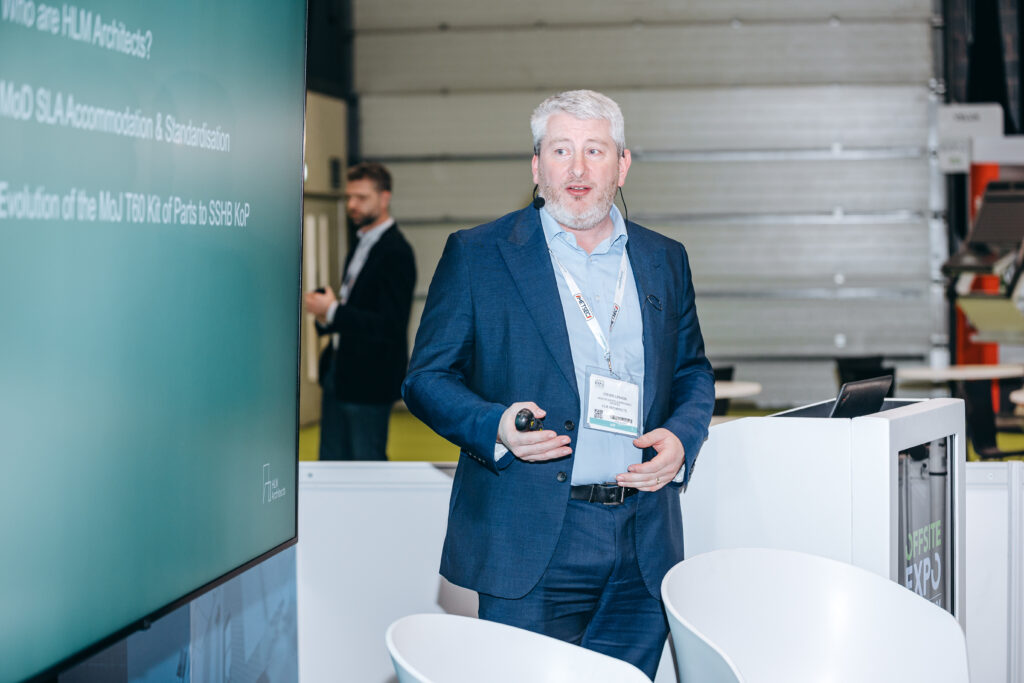
Steven says HLM have been adopters of offsite technology in their prisons since the beginning and have continued to refine the process.
“We found from very first prison that we did, which was HMP Forest Bank in Manchester, that we had MMC at the very core right from the start,” says Steven. “But what we’ve seen is an evolution.
“Initially it was all about volumetric modular, so the cell blocks were four and five-sided boxes and the process was very focused on house blocks. As things developed and we moved towards a relatively simple 2D panelised solution, and the later evolution became much more 2D oriented.
“This development was also driven by things like more restricted sites and the fact that four and five-sided empty boxes are difficult to store, and in terms of production and delivery.
“The majority of our prisons are now hybrids, they’re a mix of 3D modularised elements and 2D panelised. We would say it’s an evolved 2D panelised as the original 2D panels were a single skin or a single element. Now they’re a multi-faceted 2D-3D panel.”
Constant improvement
HLM has continued to develop and refine its methods over the years, and that has led to development of a kit of parts. This involved looking at what elements of the prison design could be repeated.
Steven adds: “The house blocks were the biggest repeatable element, and we were well on the way in terms of delivering repeatable parts, but then we looked at what other parts could be repeatable and what could be delivered through a kit of parts.
“That really allowed us to work within a set of components that are the approved prison products and the ultimate product there was the T60 House Block for HMP Five Wells.
“The big innovation with the T60 was around smaller cohorts. So effectively we had 20 cells in three legs, 60 on the ground floor, which is a 240 house block. All the science around rehabilitation, offender management, and reintegration was around those numbers and getting better outcomes.
“That ultimately led to the delivery of HMP Five Wells as part of a programme of other projects, the Advanced House Blocks and Small Secure House Blocks.
“The small secure house block programme is an evolution of the T60 into a small square house block reference design, that then becomes a site-specific design. It’s very similar to the T60s, it uses all the same components in different layouts, but using the same five or six key components.
“It’s not about reinventing when every time, it’s just about the evolution of the product. In each one of these there’s small improvements each time that are captured, fed back in and improved in the product that’s delivered.”
What’s in it for HLM?
Given that most architectural firms work on projects that could be considered more exciting than designing prisons, what is in it for HLM?
Steven says the firm is driven by a passion for rehabilitation and helping lower reoffending rates.
“What we’re interested is design for rehabilitation,” says Steven.
“The cost of reoffending is a huge number, so anything that we can do to improve that, anything we can do to save a life, anything we can do in terms of design to offer something better is hugely important for us.
“One of the small things that we’ve looked at but one of the biggest innovations is the barless windows and the benefit of that in terms of wellbeing and connecting to the Sky.
“That’s one small improvement that we’ve been able to do in terms of the development of the kit of parts. That’s really going to make a difference to prisoners’ lives and hopefully that that would deliver improvements in reoffending and prisoner wellbeing, which I think is important.
“So that’s how the 15,000 panels relate to good architecture and some good outcomes.”

Interested in reading more industry-led articles? Why not subscribe to Offsite Magazine, which features dozens of industry news stories, features, case studies and opinions just like this one.
To read the latest issue of Offsite Magazine click here and to learn more about subscribing, click here.
If you are interested in advertising in the next issue of Offsite Magazine, click here.